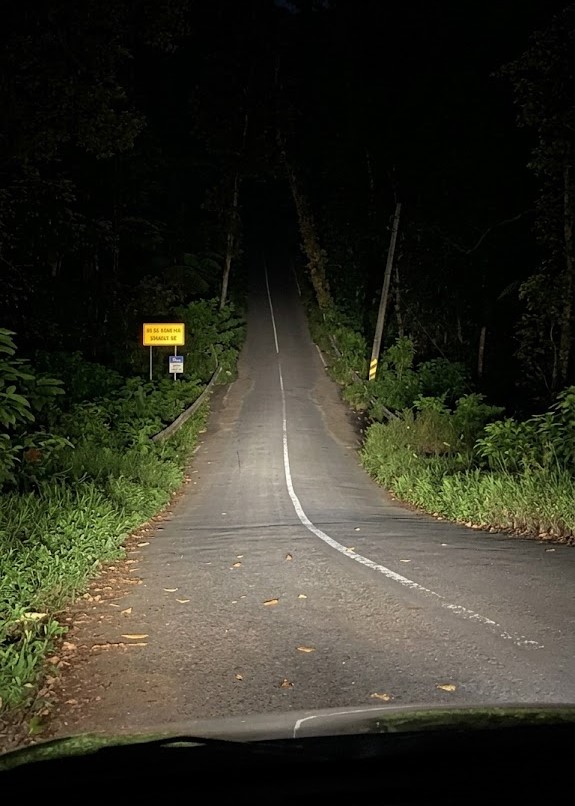
After ensuring the gas tank was full and checking the tire pressure of my beloved car, I left the city area right at 11:30 PM WIB. The city lights gradually dimmed, replaced by the glare of the car’s headlights slicing through the silence of the night. The route I took that night was not the usual path, but access to the foot of Mount Ijen, which separates Banyuwangi and Bondowoso regencies. Slowly, the bustling city began to give way to plantations, with occasional glimpses of residential areas in between. Passing through the Jambu area, the last densely populated settlement, I shifted to low gear to manage the twisting ascent of Jambu that curved right and left, directly taking me toward the base of Mount Ijen.
The Breathing Forest
As soon as I entered the Licin area and approached the forested region, the atmosphere changed drastically. The once smooth road was now flanked by walls of thick, towering trees. Because it had poured heavily earlier that afternoon, the asphalt still looked wet and glistening under the car’s lights. The road became increasingly winding, with puddles and mud occasionally visible, indicating the heavy rain that had fallen earlier.
The air coming through the window felt very different—humid, smelling of wet earth, and extremely cold. I turned off the car’s air conditioner and let the mountain air in, although I occasionally had to rub my arms to warm them up. Outside, the sounds of crickets and forest insects resonated, occasionally drowned out by the breeze rustling the high leaves on either side of the car.
Facing Challenging Terrain
Driving on this route required patience. The further up I went, the more the road began to incline at a fairly extreme angle. The car’s engine roared softly in low gear, trying to conquer one steep curve after another.
The most challenging aspect that night was the fog. Upon reaching a certain altitude, a thin fog began to descend. The remnants of rain on the road created a thin mist that drastically reduced visibility. I had to slow down, ensuring the fog lights were working at full capacity to navigate the sharp turns, which often lacked guardrails.
At certain points, the road appeared very deserted. No other vehicles were passing by. It was just me, the hard-working engine, and the beams of light occasionally catching the shadows of branches seemingly welcoming me at the roadside. There was a small feeling, a mix of awe and caution, when realizing how insignificant humans are in the grandeur of this protected forest.
Warmth at Paltuding
After navigating the winding and steep roads for about an hour, the temperature inside the car was reading lower and lower. Even on the dashboard, thin dew began to form. I tightened my jacket and occasionally sipped warm water from the thermos bottle I had prepared in the cup holder.
When the car finally rolled into the Paltuding parking area, the ache in my back instantly vanished, replaced by a sense of relief. The parking area was still quiet, with only a few other climbers’ cars that had just arrived. As soon as I opened the car door, the cold air pierced through to my bones and rushed into the cabin.
I paused for a moment inside the car, turned off the engine, and listened to the silence of the night at Paltuding. The atmosphere was magical. In the distance, there was only the darkness of the sky occasionally illuminated by flashes of stars. The journey from the city to this point was not just about moving the vehicle from point A to point B, but rather a process of “warming up” mentally before my feet truly stepped onto the actual climbing terrain.
That night, in the car that was starting to cool down, I realized that the adventure does not begin when we start climbing, but from the moment we decide to bravely penetrate the darkness of the forest alone behind the wheel.