There’s a unique sense of satisfaction when I decide to venture into the wilderness alone. The uncertainty of what lies ahead heightens the adrenaline rush, adding to the excitement and forcing us to prepare for the worst.
That night, the clock had just struck 12:30 AM Western Indonesian Time when the vehicle carrying me arrived at Pos Paltuding, the main gateway to the Ijen Crater hike. The warm air inside the car pampered me for about an hour and a half of travel. As soon as I stepped out, the cold air, around 10 degrees Celsius, immediately greeted me, seeping through my thick jacket and waking up the last remnants of sleepiness. It forced my lips and body to shiver, a normal reflex for the body to maintain its temperature.
Why and how did I end up here? I’ll tell you later. For now, my mind is only on how a mountain with an altitude of 2,443 meters above sea level can be visited by thousands of people every month. Ijen Crater, Banyuwangi. How beautiful is it to attract hundreds of eyes every day?
As a hiker who started in the 2000s, I’m accustomed to exploring trails independently. This trip to Ijen isn’t just about reaching the summit, but also about savoring every step under Banyuwangi’s star-studded night sky.
For a moment, I looked around, searching for the most strategic and comfortable coffee shop to enter. I hoped there would be a fireplace inside so I could mingle with the local residents, perhaps asking about the weather in recent days and other things while warming myself up.
First Step: Conquering the Paltuding Ascent
At 1:30 AM WIB, after a short warm-up and ensuring my headlamp and gas mask were securely packed, I began to walk. The initial hiking trail from Pos Paltuding immediately tested me with a challenging and energy-draining ascent. Trekking shoes were very helpful on the compacted sandy dirt path.
First Kilometer (Initial Ascent): This trail has a quite steep incline. Sandy volcanic dust mixed with small pebbles demanded full concentration on every step to avoid slipping. My breathing began to quicken, but a constant walking rhythm was key for hikers to conserve energy. Short steps were very helpful in maintaining stamina. Occasionally, I had to stop to catch my breath, which felt like it was lagging a few steps behind, while enjoying the profound silence of the mountain forest at night.
Second Kilometer (Gentle Slope): Fortunately, after the initial ascent, the terrain became much gentler. Here, I could straighten my back a bit, readjust my breathing pattern, and enjoy the view of Banyuwangi’s city lights at night.
Third Kilometer (Towards the Crater Rim): As we neared the summit, the trail narrowed again and became steeper with larger rocks. The night wind began to blow stronger, carrying a faint sulfurous aroma that started to prickle the nose.
At 3:15 AM WIB, I arrived at the rim of the Ijen Crater summit, standing at an altitude of 2,443 meters above sea level (mdpl). A strong wind blew directly from the crater. The “Puncak Ijen 2.443 Mdpl” plaque was visible not far from where I stood. However, the journey was not yet over. Ijen’s main magic still awaited below.
Descending the Caldera: Witnessing the Legendary “Blue Fire”
From the crater rim, I had to continue descending a steep and rocky path towards the caldera floor to witness the rare Blue Fire phenomenon. This descent path is very narrow and requires passing local sulfur miners carrying heavy loads—an extraordinary sight that showcases human resilience amidst extreme nature.
Important Note: Descending to the crater floor in the early morning requires extra caution. Wear shoes with a strong grip and ensure your chemical gas mask is tightly sealed, as sulfur gas concentrations can become very dense suddenly depending on the wind direction.
As soon as I reached the lower viewpoint, a beautiful panorama unfolded. If you turn off your lights, cracks in the rocks emit bright, electric blue flames. This Blue Fire phenomenon occurs due to the release of high-temperature sulfur gas that immediately reacts with free oxygen in the air. There are only two places in the world that offer this wonder, and standing before it directly provides a magical sensation that is difficult to describe in words.
Welcoming the Dawn and the Splendor of the Turquoise Lake
As it approached 4:30 AM WIB, I climbed back up towards the summit to secure a position to welcome the sunrise. Watching the sunrise from the easternmost tip of Java might make me the first person on Java to greet the morning sun that day.
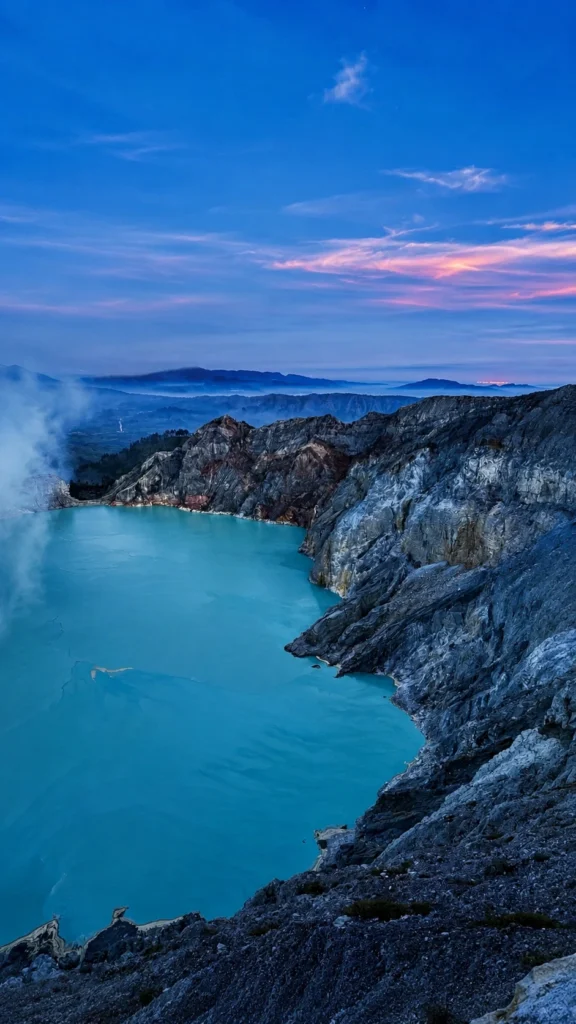
As dawn began to break on the eastern horizon, golden rays slowly swept across the caldera landscape. Here, the charm of Ijen Crater revealed its full form, surrounded by the majestic volcanic caldera cliffs. The lake’s water is the world’s largest acidic lake, reflecting a bright green color that contrasts with the surrounding bright yellow sulfurous rocks. The sulfurous smoke from the sulfur mine I visited earlier was swept away and danced above the lake’s surface, an unforgettable sight that seemed to erase all fatigue. Not many mountain peaks have craters with such beautiful lakes, no wonder its name is so famous, even internationally. Thousands of people visit it every month, flooding their social media with the beauty of the Ijen crater landscape, making its name increasingly famous every day.
The morning sunlight was not enough to overcome the cold temperature and strong winds coming from the crater. I satisfied my eyes by looking around one last time before deciding to begin my journey back.
The descent back to Pos Paltuding took about an hour, with the morning sunlight warming my stiff muscles. Approaching 8:00 AM WIB, I arrived back at the starting point, concluding this solo hike with a cup of hot coffee at a local shop right in front of the Ijen Crater gate.
Ijen Crater Hiking Information Summary:
Location: Border of Banyuwangi and Bondowoso Regencies, East Java. Access from Banyuwangi.
Summit Altitude: 2,443 mdpl.
Best Hiking Season: Dry season (April – October) to ensure the trail is not slippery.
Mandatory Gear: Headlamp, windproof/thick jacket, gas mask/respirator, gloves, and hiking boots.
Are you interested in challenging yourself to enjoy the wonders of the night and the grandeur of the dawn at Ijen Crater on your next holiday?